![Idigitalie Logo [1]](https://idigitalise.net/wp-content/uploads/2025/11/Idigitalie_Logo_1.png)
- Case Studies
-
- Our Work
-
-
-

We serve top companies and the fastest-growing startups. iDigitalise boosts conversion rates.
-
-
-
- Pricing
-
- About
-


We serve top companies and the fastest-growing startups. iDigitalise boosts conversion rates.

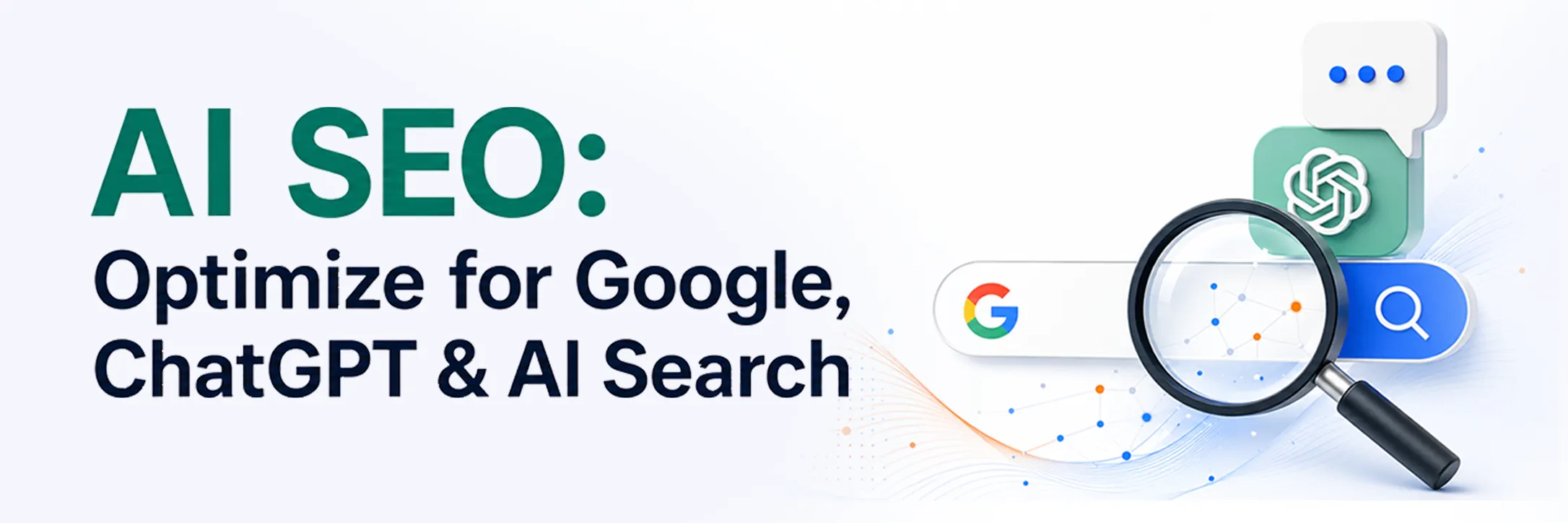
Search is not going away. It’s changing how people discover businesses.
A few years ago, the typical search journey was fairly predictable. Someone searched Google, reviewed several results, clicked a few websites, compared their options, and eventually contacted a business.
In 2026, that journey can look very different.
A potential customer might search Google, get an AI-generated answer, continue researching through AI Mode, ask ChatGPT for recommendations, compare several companies, and visit only two or three websites before making a decision.
For businesses, that creates an important question:
The answer isn’t to abandon SEO and chase every new AI optimization trend. Strong technical SEO, useful content, search intent, website authority, internal linking, and a good user experience still matter.
What is changing is the goal.
Businesses shouldn’t think only about ranking #1 on Google. They increasingly need to think about whether their company can be discovered, understood, cited, trusted, and considered across both traditional and AI-powered search.
The purpose of this guide is to understand AI SEO optimization in 2026 and provide some tips on how companies can enhance their visibility on Google, ChatGPT, AI Overviews, AI Mode, and other AI searches.
AI SEO refers to the optimization of your website, content, and digital assets to appear visible in search through not only conventional search engines but also through AI-based searches.
Examples are:
There are also other terms related to AI SEO like Generative Engine Optimization (GEO), Answer Engine Optimization (AEO) or LLM optimization.
The terminology is evolving quickly, but businesses don’t need a completely different marketing strategy for every new acronym.
Google’s guidance is particularly useful here: there are no special technical requirements that websites need to implement solely to appear in Google’s AI features. The same fundamental SEO practices continue to apply.
A practical way to think about AI SEO is:
Strong SEO foundations + useful content + clear expertise + technical accessibility + genuine brand authority.
AI SEO doesn’t replace SEO. It expands where SEO can create visibility.
Traditional SEO and AI Search Optimization are quite similar. The biggest difference is how people search and how information is presented back to them.
| Area | Traditional SEO | AI Search Optimization |
| Primary Goal | Rank in search results | Be discovered, understood, cited or recommended |
| Search Behavior | Keyword-focused searches | Longer, conversational questions |
| Content Focus | Keywords + search intent | Intent + context + useful answers |
| Technical SEO | Essential | Still essential |
| Authority | Backlinks and reputation | Authority, citations, mentions and reputation |
| Original Experience | Valuable | Increasingly important |
| Brand Signals | Important | Increasingly important |
| Success Metrics | Rankings, clicks, traffic | Visibility, citations, traffic, leads and conversions |
This is why businesses shouldn’t choose between SEO and AI SEO.
The better strategy is to build an SEO foundation strong enough to perform as search behaviour continues to evolve.
Yes. Traditional SEO is still the backbone.
AI search systems still need useful, accessible information to understand topics, businesses, products, services, and entities.
That means businesses should continue investing in areas such as:
What is becoming less effective is creating large volumes of generic content simply because a keyword has search volume.
AI can generate basic information extremely quickly. If your article says essentially the same thing as 100 other websites, there is little reason for a user—or an AI-powered search experience—to consider it particularly valuable.
The opportunity now lies in creating content that brings something useful to the conversation.
ChatGPT Search can search the web and provide users with answers that include links to relevant web sources.
For companies that want their public content to become discoverable via ChatGPT Search, technical accessibility is a must.
OpenAI mentions OAI-SearchBot as the crawler for searches. Companies should ensure that their important public content is not blocked by mistake if they want it to be eligible for ChatGPT Search.
| Technical Check | Why It Matters |
| OAI-SearchBot access | Helps in making public content discoverable for ChatGPT Search |
| Googlebot access | Helps Google crawl important pages |
| Indexability | Importance of having important pages accessible for crawlers |
| robots.txt | Prevent accidental crawler blocking |
| XML sitemap | Helps in finding important URLs |
| Internal linking | Helps in finding related content |
| Canonical tags | Clarify which URL to prefer |
| HTTPS | Ensures the safety of websites |
There is no switch that would guarantee your company will show up in an AI answer.
The objective is to make sure your website is technically accessible, and your content gives search systems something genuinely useful to work with.

There is no single AI SEO trick.
Sustainable visibility comes from combining several areas that have always mattered in SEO with a stronger focus on originality, expertise, context, and brand authority.
Here are the areas businesses should prioritize.
The importance of keyword research hasn’t gone away; the keyword is just the start of the story.
You also have to know why someone is searching.
Consider these searches:
| Search Query | Likely Intent |
| AI SEO | Research |
| AI SEO optimization | How to optimize |
| SEO for ChatGPT | Problem solving |
| AI SEO agency | Commercial research |
| ChatGPT SEO services | Transactional |
| Best AI SEO agency | Highly commercial |
A person searching “AI SEO optimization” isn’t looking for a definition.
They want to understand:
A strong page should answer the complete intent instead of repeating the target keyword throughout the article.
Write for the question behind the keyword.
People use AI search partly because they want answers quickly.
Your content should respect that behaviour.
If someone asks whether SEO still matters in the age of ChatGPT, don’t hide the answer beneath 600 words of background information.
Give them the answer, then provide depth.
For example:
Does SEO still matter with ChatGPT and AI search?
Certainly. The relevance of traditional SEO comes from the fact that although there is now AI-driven SEO, AI-driven search cannot work without access to good-quality and relevant web content. The only thing that changes is that companies need to move away from just thinking about rankings.
Clear answers will help make the purpose of each of the sections clearer.
This may be one of the biggest opportunities in AI-era SEO.
Think about how much generic content already exists online.
Thousands of articles explain:
Rewriting those definitions isn’t a competitive advantage.
Instead, create information worth referencing.
Citation-worthy content can include:
Compare these examples:
| Generic Content | More Valuable Content |
| SEO helps businesses get traffic | Actual organic growth case study |
| Landing pages improve conversions | Before-and-after conversion data |
| Website speed matters | Performance improvement example |
| Google Ads can generate leads | Real CPL or conversion comparison |
| AI is changing search | Examples of changing customer search journeys |
The second type of content gives readers a reason to remember your company and other websites a reason to reference your work.
One of the best ways to differentiate content in an AI-heavy environment is to include something AI cannot independently create for your business:
your actual experience.
If you’re an SEO agency, don’t only explain SEO principles. Show how you’ve applied them.
If you’re a web development company, don’t only explain good website design. Show examples of problems you’ve solved.
Useful proof can include:
Instead of saying:
“Improving landing pages can increase conversions.”
Explain what you changed, why you changed it, and what happened afterward.
That makes content more useful to readers and considerably harder for competitors to replicate.
A common SEO mistake is choosing 30 unrelated keywords and publishing 30 isolated articles.
A stronger strategy is to build topic clusters around services your business actually wants to sell.
For example, a web development cluster could include:
| Core Topic | Supporting Content |
| Web Development | Web Development vs. Web Design |
| Web Development | Professional Website Cost |
| Web Development | Mobile-First Web Design |
| Web Development | Core Web Vitals |
| Web Development | UX and SEO |
| Web Development | Website Maintenance |
| Web Development | Landing Page Optimization |
An SEO cluster could include:
Internal linking will tie all these pages together.
In conclusion, the final outcome is a website that shows depth about the subject matter rather than posting standalone articles for each keyword.
Internal linking remains one of the simplest SEO opportunities businesses overlook.
Quality internal links not only allow people to find relevant information but also assist search engines in understanding relationships between pages.
For instance, a page about AI SEO might link people to such services as:
The point is not to link each time a keyword pops up.
The link should genuinely help the reader continue their journey.
A useful lead-generation path looks like this:
| Stage | Example |
| Discovery | AI SEO article |
| Education | Technical SEO / Content guide |
| Commercial Research | SEO Services |
| Proof | SEO Case Study |
| Conversion | SEO Audit / Consultation |
This is where SEO begins moving from traffic generation to lead generation.
SEO content doesn’t need to look like an academic paper.
Even if it is a lengthy article with over 2,000 words, it should be written in such a way that a person can easily scan through it and get the main ideas.
To achieve this goal, use:
Do not convert each sentence into a separate paragraph just because it provides you with more white space.
Good readability is not achieved through fragmented sentences.
Your company will not exist only on your website online.
There are ways for creating a solid digital presence, such as:
It does not mean that you have to register your company on hundreds of irrelevant directories.
Try to find the websites that can be visited by your real clients, journalists, partners, or professionals in your industry.
The idea is to develop an online presence that reflects who you are, what you do, and how you are recognized.

Backlinks are still important, but contemporary authority building needs to transcend link building.
Companies need to strive for:
One effective digital PR initiative has the potential of providing:
| Benefit | Potential Impact |
| Backlinks | SEO authority |
| Brand mentions | Online presence |
| Referral traffic | New visitors |
| Branded searches | Brand demand |
| Expert positioning | Builds trust |
| Media coverage | Expands reach |
The best backlinks and mentions are usually earned because your company provided value.
Structured data assists search engines in comprehending some data on your website pages and can make eligible data available for special search appearances.
Depending on your website, relevant structured data may include:
Structured data should accurately represent the information users can see on the page.
Don’t treat schema as an AI-ranking hack.
It’s another way to make your website clearer and more structured for search systems.
Search is becoming increasingly multimodal.
That means valuable content doesn’t always need to be text.
Depending on the topic, useful visual assets can include:
For example, an article explaining a complex website architecture may become far more useful with one well-designed diagram than another 500 words of explanation.
Use multimedia when it improves understanding, not simply because an SEO checklist tells you to add a video.
The role of technical SEO has not been replaced by AI-based search.
It is still important for your website to be:
Technical problems can limit your high-quality content from achieving all organic opportunities.
Companies need to regularly check the following:
| Technical Area | What to Check |
| Indexing | Is the page indexed? |
| Crawling | Are the pages accessible for the search robots? |
| Page Speed | Do the pages work well? |
| Mobile | Is the site mobile-friendly? |
| Canonicals | Are preferred URLs clear? |
| Redirects | Are redirects implemented correctly? |
| Sitemap | Is the XML up-to-date? |
| Internal Links | Can important pages be discovered easily? |
| HTTPS | Is the entire site secure? |
AI SEO starts with a website that search systems can actually access.
Traditional search queries are often short.
AI conversations can be much more detailed.
Rather than researching;
“website development cost”
people could ask:
“How much budgeting is needed to make a good-quality website for small businesses in the US?”
Whereas rather than;
“SEO agency”
someone could ask:
“What kind of SEO agency do I need if I want my website visible in Google and ChatGPT?”
That does not imply creating a unique page for each and every question.
Rather, create detailed pages that naturally answer the questions asked by customers.
A good topic should cover:
Content that reflects actual customer intent, not just variations on keywords.
Your site needs to spell out basic information about your business.
Search engines, artificial intelligence, and consumers should all be able to easily understand:
Work on improving important web pages including:
If you yourself can’t easily communicate what your business does through your website, how will anyone else?
AI, SEO, digital marketing, software, and technology are dynamic.
Important content should therefore be reviewed periodically for accuracy.
Check:
Simply changing “2025” to “2026” doesn’t make an article fresh.
A genuine update should improve the information.
The tools are changing, but one principle remains consistent: visibility alone isn’t the end goal.
A business can increase rankings, impressions, and website traffic without seeing the same improvement in qualified enquiries.
That’s why at iDigitalise, we look at AI search as part of the broader customer discovery journey rather than treating it as a completely separate marketing channel.
Our approach connects five important areas:
| Area | What We Focus On |
| Technical SEO | Making important content accessible, crawlable, fast and well structured |
| Search Intent | Understanding what potential customers are actually searching and asking |
| Content | Creating useful pages built around genuine expertise rather than publishing for volume |
| Authority | Strengthening credibility through content, relevant links, mentions and digital PR |
| Conversion | Creating clear paths from search visibility to enquiries, calls, bookings or sales |
The question isn’t simply:
“Can this page rank?”
We also ask whether the right visitor who discovers that page can quickly understand the business, trust what they’re reading, and take the next step.
As search journeys spread across Google, ChatGPT, social platforms, AI-generated answers, and traditional websites, that connection becomes even more important.
The discovery channel may change.
The business objective remains the same: get found by the right audience, earn their trust, and turn relevant visibility into measurable opportunities.
Growing interest in AI search has also created plenty of questionable optimization advice.
Businesses should be careful about chasing shortcuts.
| Avoid | Do This Instead |
| Publishing hundreds of generic AI articles | Create fewer, stronger resources |
| Stuffing AI keywords everywhere | Write naturally around search intent |
| Creating a page for every prompt variation | Build comprehensive topic pages |
| Ignoring traditional SEO | Strengthen technical and on-page fundamentals |
| Publishing without expert input | Add genuine first-hand experience |
| Chasing every GEO “hack” | Focus on sustainable fundamentals |
| Blocking important crawlers | Review crawler accessibility |
| Writing only for AI | Write primarily for customers |
| Rewriting competitor articles | Add original insight |
| Measuring only rankings | Measure leads and business outcomes |
AI can make content production faster.
It shouldn’t make your website more generic.
AI-assisted content can perform in search. The more important question is whether the final content is useful, accurate, original, and created to help users rather than simply fill a publishing calendar.
AI could be useful in:
Human input can help in the following ways:
Businesses should follow a format which includes:
AI-assisted and expertise-reviewed and experience-driven and customers-driven format.
AI can make the entire process faster.
It is you who adds value to the entire result.
No. A better way to describe Generative Engine Optimization (GEO) would be to consider it an extension of contemporary search techniques instead of a substitute for SEO.
The basic concepts are very much related.
| SEO Foundation | AI Search Evolution |
| Technical SEO | AI crawler reachability |
| Keyword research | Conversational search intent |
| Helpful content | Authority information |
| Backlinks | Greater authority and reach |
| Internal linking | Topical relevance |
| Expertise | Personal experience |
| Rankings | AI visibility and authority |
| Organic traffic | Search + AI referrers |
Businesses do not have to pick between SEO and GEO.
They have to develop a search strategy that can adjust to evolving customer behaviour.
Ranking reports have their merits, but they should not be the sole determinant of SEO performance.
Businesses should monitor a wider set of performance indicators.
| Metric | What It Tells You |
| Keyword Rankings | Traditional organic visibility |
| Organic Clicks | Traffic from search engines |
| Organic Impressions | Search visibility |
| AI Referral Traffic | Visitors arriving from AI platforms |
| Brand Searches | Growth in brand awareness |
| Organic Leads | Direct business impact |
| Conversion Rate | Quality of traffic |
| Assisted Conversions | Search’s role in customer journeys |
| Brand Mentions | Broader digital authority |
| Engaged Sessions | Whether visitors find content useful |
Most importantly, connect SEO reporting with actual business outcomes.
A ranking is useful.
A qualified enquiry is better.
If you don’t know for certain whether the search engines and AI technology can crawl, understand and index your website content, then an audit would be a good place to begin.
An audit for SEO and AI search optimization would cover:
The objective is not just to come up with more keywords.
It’s all about figuring out what’s preventing your website from getting more visibility and converting it into business.
Request an SEO & AI Search Audit →
Use this checklist to review your current website.
| Area | Question to Ask |
| Technical SEO | Can search engines crawl and index important pages? |
| AI Crawlers | Are relevant search crawlers accidentally blocked? |
| Search Intent | Does each page solve the right customer problem? |
| Content Quality | Is the information genuinely useful? |
| Experience | Does the information prove your experience? |
| Originality | Does it offer something that other brands lack? |
| Structure | Is the layout clear and understandable? |
| Internal Links | Are the links relevant? |
| Brand | Does the brand get the representation it deserves online? |
| Authority | Are the credible sources talking about you? |
| Structured Data | Is relevant schema implemented correctly? |
| Multimedia | Would original visuals improve the page? |
| Conversion | Is there a logical next action? |
| Measurement | Are traffic and leads being tracked? |
If several answers are no, you may not need an entirely new “AI SEO strategy.”
You probably need to strengthen the foundations of your existing search presence first.
1. What is AI SEO?
AI SEO is the practice of improving websites and content for visibility across both traditional search engines and AI-powered search experiences such as Google AI Overviews, AI Mode and ChatGPT Search.
It combines proven SEO fundamentals with greater attention to conversational intent, original expertise, clear content structure, authority, technical accessibility, and brand visibility.
2. Does SEO still work in 2026?
Yes. Since search engines and AI search engines use accessible information from across the internet, the importance of SEO won’t be going anywhere soon.
But businesses should move away from thinking about success purely in terms of search engine rankings and start focusing on visibility, lead generation, brand searches, conversions, etc.
3. Can I optimize my website for ChatGPT?
Making your content technically accessible and publishing useful, authoritative information would make your website more eligible for discovery through ChatGPT Search experience.
No guaranteed technique would force ChatGPT to include your business in its search suggestions.
4. How do I get my business mentioned by ChatGPT?
There is no surefire recipe. Your primary goal would be to build online visibility and establish digital authority of your business. It would involve creating and promoting useful content, establishing your expertise, getting relevant third-party mentions, etc.
5. Does Google have special SEO requirements for AI Overviews?
Google has stated that websites don’t need to undergo any special technical optimization to appear in its AI search experiences. Strong existing SEO fundamentals remain important.
6. What is Generative Engine Optimization?
Optimization of digital content and brand visibility for AI search experiences is commonly known as Generative Engine Optimization, or GEO.
In practice, many GEO activities overlap significantly with modern SEO.
7. Is GEO better than SEO?
Neither should be viewed as a replacement for the other. Traditional SEO provides the technical, content, and authority foundations that can also support visibility across generative search experiences.
8. Should businesses use AI to write SEO content?
AI technologies could assist businesses with research, outlines, editing, organization, and drafts creation. But it seems that massive publishing of generic content without expertise, verification, originality, or editorial decisions would not provide a significant competitive advantage.
9. What is the future of SEO with AI?
SEO wouldn’t go anywhere. Businesses will have to work both on ranking and on optimizing their content and authority for discovery through AI search experiences.
With ChatGPT, Google AI Overviews, AI Mode and other AI-driven search experiences becoming more prevalent, it doesn’t imply that organizations should forsake their SEO strategies.
It means the definition of search visibility is getting broader.
The traditional journey was often:
Keyword Search → Ranking → Click → Website
The modern journey can look more like:
Question → Search/AI Discovery → Brand Evaluation → Website Visit → Enquiry
Businesses still need technically strong websites, relevant keywords, useful content, backlinks, and clear website architecture.
But they increasingly also need:
The businesses that benefit most from AI search won’t necessarily be the ones publishing the most content.
They’ll be the businesses creating useful, credible, original content around topics they genuinely understand.
Search is changing, but your business objective hasn’t: be found by the right people and turn that visibility into opportunities.
At iDigitalise, we connect SEO with content strategy, technical optimization, web development, digital authority, analytics, and conversion optimization rather than treating rankings as the final objective.
You don’t need to chase every new AI search trend.
You need a search strategy built on strong fundamentals that can evolve as the way your customers search changes.
Want to know where your website currently stands? Start with an SEO & AI Search Audit.