


![Idigitalie Logo [1]](https://idigitalise.net/wp-content/uploads/2025/11/Idigitalie_Logo_1.png)
- Case Studies
-
- Our Work
-
-
-
We serve top companies and the fastest-growing startups. iDigitalise boosts conversion rates.
-
-
-
- Pricing
-
- About
-


We serve top companies and the fastest-growing startups. iDigitalise boosts conversion rates.

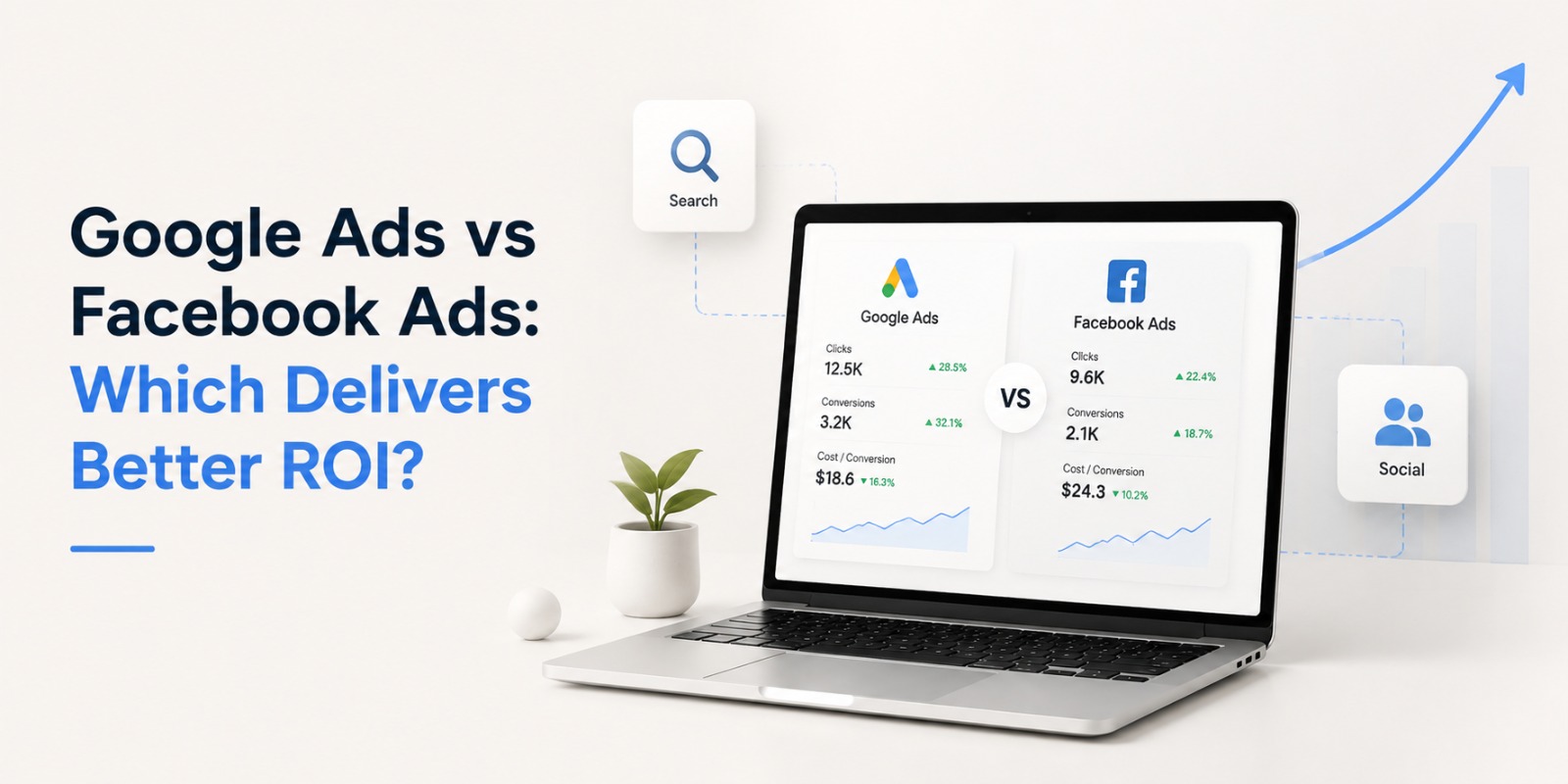
If your advertising budget is limited, one of the first questions that come up is:
Do you invest in Google Ads or Facebook Ads?
Both options can help you generate sales and leads. Both options feature sophisticated AI-driven advertising optimization. Both can waste money quickly when tracking, targeting, creative, or campaign structure is weak.
The difference is how they reach potential customers.
Google Ads performs well when the users are ready to search for whatever they need. Facebook/Instagram ads can work better when you need to create demand or reach people who do not yet know about your offer.
Now, which one will offer you a higher ROI in 2026?
In reverse, it might be that the Google Ads work well in case of search intent, and Facebook Ads may work well when it comes to scalability and demand generation.
But there is no general principle that applies in this case.
It really comes down to the industry, product, sales cycle, target audience, creatives, conversion tracking, etc.
This guide breaks down Google Ads vs Facebook Ads from a business perspective so you can decide where your budget is more likely to produce results.
If you only want the short answer, start here.
| Area | Google Ads | Facebook / Meta Ads |
| Core Strength | Capturing existing demand | Creating and capturing demand |
| User Intent | Often high | Usually lower initially |
| Best For | Search-driven products and services | Visual products, discovery and audience building |
| Targeting | Keywords, intent, audience signals | Audience, behavior, interests, first-party data |
| Lead Quality | Can be very strong | Varies significantly by targeting and offer |
| Creative Importance | Important | Extremely important |
| Search Requirement | Customer usually needs to be searching | Customer does not need to be searching |
| E-commerce | Strong | Strong |
| B2B Lead Generation | Often strong | Can work well with the right audience and offer |
| Local Services | Very strong | Strong for awareness and lead campaigns |
| Remarketing | Strong | Strong |
| AI Automation | Smart Bidding, Performance Max | Advantage+ |
| Best Overall Strategy | Capture intent | Create and scale demand |
The real decision isn’t simply Google Ads or Facebook Ads.
It is understanding where your customer is in the buying journey.
Through Google Ads, firms can target their prospective clients through Google’s advertising network such as Search and other Google platforms.
For most businesses comparing Google Ads with Facebook Ads, the most important advantage is search intent.
Someone searching:
is already expressing a need.
Google Ads allows businesses to appear while that need is active.
That can make it particularly effective for industries where people actively search before buying.
There has been increasing automation within Google Ads.
The Google Smart Bidding feature utilizes Google’s AI to adjust bids to generate conversions or conversion value. Strategies include Maximize Conversions, Targetgoogle CPA, Maximize Conversion Value, and Target ROAS.
Performance Max goes further by using Google AI across bidding, audience signals, creative, budget optimization, attribution, and multiple Google channels.
For advertisers, that means campaign performance increasingly depends on feeding the platform better information.
Important inputs include:
Automation can optimize what you give it.
It cannot repair a weak offer or poor conversion tracking.
Facebook Ads are part of Meta’s advertising ecosystem and can reach users across platforms and placements including Facebook and Instagram.
Unlike Google Search Ads, users generally aren’t opening Facebook or Instagram because they want to search for a particular product or service.
That creates a different advertising environment.
Instead of responding to existing demand, Meta Ads can help businesses introduce an offer to people who may be likely to care about it.
This makes Facebook and Instagram particularly powerful for:
A strong Meta campaign can put an offer in front of someone before they ever think to search for it.
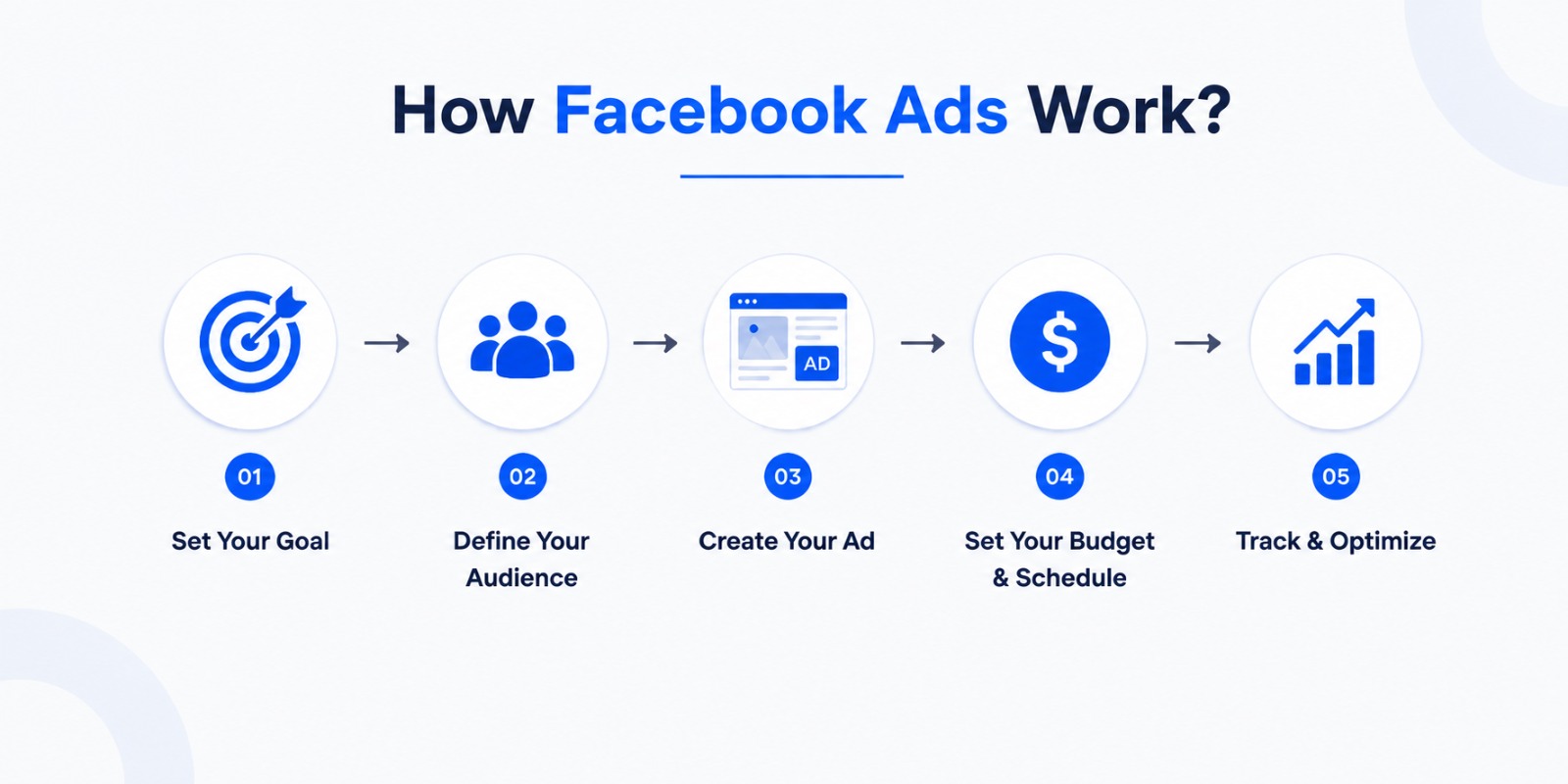
Meta is also increasingly AI-driven.
Its Advantage+ suite uses AI and automation across areas such as audiences, placements, budget allocation, sales, and lead generation. Meta says Advantage+ can expand beyond advertiser-provided audience suggestions when its system predicts doing so may improve performance.
Meta’s Advantage+ campaign budget can also automatically distribute campaign spend across ad sets based on performance opportunities.
For lead generation, Meta currently offers Advantage+ leads campaigns designed to use AI-driven optimizations across the campaign setup.
That means modern Facebook advertising is less about manually building dozens of tiny interest audiences and more about giving Meta:
Creative has become particularly important because the ad itself helps the system understand who may respond.
The simplest difference is intent.
Imagine two people.
Person A searches Google:
“best accounting firm for small business near me.”
Person B is scrolling Instagram and sees an ad from an accounting firm explaining:
“5 tax mistakes costing small businesses thousands every year.”
Both people could become customers.
But they entered the marketing funnel differently.
| Google Ads | Facebook Ads |
| Responds to an existing need | Can create awareness of a need |
| Customer often initiates discovery | Advertiser initiates discovery |
| Search intent can be very high | Interest may need to be developed |
| Strong for bottom-funnel demand | Strong across awareness and consideration |
| Keyword/search data is central | Creative and audience signals are central |
This distinction explains why comparing only cost per click can be misleading.
A $10 Google click from someone ready to buy can be worth far more than a $1 social click from someone casually browsing.
And a low-cost Meta impression that introduces your brand to thousands of potential customers can create demand that later converts through Google.
The channels can compete.
They can also support each other.
There is no reliable universal answer.
ROI depends on what happens after the click, not simply what the advertising platform charges.
A simplified calculation looks like this:
Advertising ROI = Revenue Generated From Ads ÷ Advertising Investment
But serious advertisers should go deeper.
For lead generation, track:
For e-commerce, track:
A campaign producing 100 cheap leads isn’t necessarily better than one producing 30 expensive leads.
If only five of the cheap leads are qualified but 20 of the more expensive leads are qualified, the second campaign may be far more profitable.
The cheapest lead is not always the best lead.
Google Ads is often the stronger starting point when customers actively search for the product or service you provide.
Examples include:
The key advantage is timing.
Your business can appear when the person is already looking for an answer.
| Situation | Why Google Can Work Well |
| Customers actively search for your service | Strong existing intent |
| Your offer solves an urgent problem | Users need a solution now |
| Your service has clear keywords | Easier intent targeting |
| You sell high-value services | Higher CPC can still be profitable |
| You operate locally | Geographic + search intent can be powerful |
| Leads have high lifetime value | Higher acquisition costs may still make sense |
For these businesses, Google Ads can act like a digital version of being visible exactly when the customer raises their hand.
Facebook and Instagram Ads can perform particularly well when the product or service benefits from discovery, visual storytelling, or demand creation.
Examples include:
Meta’s huge advantage is that the customer doesn’t need to know your product exists before seeing your advertisement.
| Situation | Why Facebook/Instagram Can Work |
| Your product is visual | Creative can generate immediate interest |
| Customers aren’t actively searching | Meta can create demand |
| You need broader reach | Social platforms enable audience expansion |
| Your offer needs explanation | Video and creative can educate |
| You have strong first-party data | Signals can support AI optimization |
| You want retargeting | Social reminders can bring visitors back |
Meta’s Advantage+ audience can use advertiser inputs as suggestions while expanding beyond them when the system predicts additional opportunities.
That makes the quality of your offer, tracking, and creative increasingly important.
If the main goal is lead generation, don’t compare platforms purely by the number of form fills.
Compare what happens after the form is submitted.
| Metric | Google Ads | Facebook Ads |
| Lead Intent | Often higher | Often requires more qualification |
| Lead Volume | Depends on search demand | Can scale through larger audiences |
| Lead Form Friction | Usually landing page | Can use website or native forms |
| Cost Per Lead | Can be higher | Can appear lower |
| Qualification | Often stronger for high-intent search | Depends heavily on funnel |
| Scalability | Limited partly by available search demand | Can expand audiences more easily |
A Facebook campaign may generate leads for $20 while Google produces leads for $50.
At first glance, Facebook looks better.
But suppose:
| Metric | Facebook Ads | Google Ads |
| Leads | 100 | 40 |
| CPL | $20 | $50 |
| Spend | $2,000 | $2,000 |
| Qualified Leads | 15 | 25 |
| Sales | 3 | 8 |
Now the picture changes completely.
The correct question isn’t:
“Which platform gives cheaper leads?”
It is:
“Which platform gives us customers at a profitable acquisition cost?”
For e-commerce businesses, both platforms can be extremely valuable.
Google can capture shoppers who already know what they’re searching for.
Meta can create desire before a search happens.
Google is useful for:
Meta is useful for:
Google says Performance Max uses AI across its inventory to optimize toward advertiser-defined conversion goals and can expand reach beyond keyword-based Search campaigns.
Meta says Advantage+ sales campaigns automate areas including creative, targeting, placements, and budget to help advertisers drive online sales.
For many growing e-commerce businesses, the strongest strategy isn’t choosing one.
It is using each platform for the job it does best.
B2B advertising requires a slightly different approach because the buying cycle is often longer.
Google can be particularly effective when decision-makers actively search for:
Meta can still contribute by:
For B2B, the strongest campaign often uses multiple touchpoints.
A buyer may first see your company on Facebook or Instagram, later search your brand on Google, read a case study, return through remarketing, and eventually submit a form.
Giving 100% of the credit to the final click doesn’t reflect that journey.
Google Ads usually deserves serious consideration for local businesses because location and high-intent search can work extremely well together.
Businesses such as:
can reach people searching directly for nearby solutions.
Facebook Ads can then complement that by building local visibility and reaching potential customers who aren’t currently searching.
A practical local strategy might look like this:
| Channel | Role |
| Google Search Ads | Capture people actively searching |
| Facebook/Instagram | Build awareness locally |
| Meta Remarketing | Re-engage website visitors |
| Google Remarketing | Maintain consideration |
| Google Business Profile | Strengthen local organic visibility |
Instead of asking which platform replaces the other, consider how they can support the same customer journey.
The answer depends on what you mean by targeting.
Google’s greatest targeting advantage is knowing what someone is actively searching for.
A keyword such as “enterprise SEO agency” provides a strong signal about what that user wants at that moment.
Google also uses many contextual and audience signals within its automated bidding systems. Smart Bidding evaluates signals such as device, location, browser, language, time, and other context at auction time.
Meta’s strength is discovering potential customers based on signals across its ecosystem.
Advantage+ audience lets advertisers provide audience suggestions while Meta’s AI can search more broadly for people likely to respond to the campaign objective.
The difference can be summarized simply:
Google often knows what someone wants right now. Meta can be very good at predicting who may be interested before they search.
Neither platform is universally cheaper.
Advertising costs depend on:
Facebook Ads may often produce cheaper clicks or leads, while Google Ads may produce stronger intent.
But cost per click isn’t a business outcome.
Consider this:
| Campaign | CPC | Conversion Rate | Cost Per Lead |
| Campaign A | $2 | 2% | $100 |
| Campaign B | $5 | 10% | $50 |
Campaign B has a much more expensive click but a much cheaper lead.
That is why focusing on CPC alone can lead to poor budget decisions.
One of the most important parts of paid advertising in 2026 is measurement quality.
Both Google and Meta increasingly use conversion data to optimize campaign delivery.
Conversion tracking is mandatory in case of using Google Smart Bidding strategy. Value-based strategies also require good conversion values.
Meta’s Conversions API provides a direct connection between business marketing data and Meta’s optimization systems. Meta says it can support ad optimization and measurement and can be used alongside the Meta Pixel for website events.
For lead-generation businesses, don’t stop tracking at:
Form Submitted
Where possible, feed the business outcome back into your reporting.
Track stages such as:
If your platform only knows which users complete a form, it may optimize toward people who complete forms.
If your measurement system can identify which leads become real customers, your optimization can become much more aligned with business value.
You can have excellent targeting and still lose money if the landing page doesn’t convert.
A strong landing page should quickly answer:
Common landing-page problems include:
Paid advertising doesn’t end when someone clicks.
The click is where your website starts doing its job.
For businesses investing heavily in advertising, improving conversion rate can sometimes create more value than simply increasing the media budget.
Creative is especially important for Meta campaigns, where the advertisement often needs to interrupt someone’s scrolling and create interest.
Strong paid-social creative may include:
Meta’s own performance guidance emphasizes creative diversification so its delivery system has different messages and formats to work with.
Google also increasingly uses creative assets across automated campaign types such as Performance Max.
In both platforms, automation makes better inputs more valuable, not less.
Use this decision table as a starting point.
| Your Goal | Stronger Starting Point |
| Capture high-intent searches | Google Ads |
| Generate immediate local enquiries | Google Ads |
| Launch a visually appealing product | Facebook/Instagram Ads |
| Create demand for something new | Facebook/Instagram Ads |
| Generate B2B search leads | Google Ads |
| Build broad awareness | Facebook/Instagram Ads |
| Retarget visitors | Both |
| Scale e-commerce | Both |
| Promote a webinar | Meta + Google remarketing |
| Capture urgent service searches | Google Ads |
| Reach people before they search | Facebook/Instagram Ads |
| Build a full-funnel strategy | Both |
For many businesses, the best answer is not one platform.
It’s deciding which platform should do which job.
Combining both platforms may help build a better picture of the customer acquisition funnel.
A simple example:
Step 1: Meta Creates Awareness
Your potential client sees an amazing Facebook or Instagram advertisement and learns about your product.
Step 2: They Research
He/She visits your web site, reads your service pages, or leaves without making the conversion.
Step 3: They Search Google
Next time, he/she searches for solutions and gets to your Google Search Ad.
Step 4: Remarketing Reinforces the Brand
The client sees another related ad while researching.
Step 5: They Convert
At some point, he/she decides to make a conversion through Google, Meta, organic search or direct traffic, and enquires.
This is why assessing each platform in isolation may understate its importance.
People don’t think about their purchasing journey through your advertising dashboard.
Google Ads campaigns can be very expensive if the basics are ignored.
Some common pitfalls:
Automation is not a reason to ignore strategy.
It makes accurate goals and data even more important.
Meta Ads have their own common problems.
These include:
Meta recommends simplified account structures partly because campaigns need sufficient data and stability for the delivery system to learn effectively.
The goal is not to interfere with automation constantly.
It is to give the system better inputs and judge results against real business outcomes.
The question we ask isn’t simply:
“Which platform has the lowest cost per lead?”
A cheap lead is of little value if the sales team can’t convert it.
Instead, we look at paid media across the complete acquisition journey.
| Area | What We Focus On |
| Platform Strategy | Choosing the right role for Google and Meta |
| Conversion Tracking | Measuring actions that actually matter |
| Campaign Structure | Giving campaigns enough clarity and data |
| Search Intent | Capturing people actively looking for solutions |
| Creative | Building messages that generate attention and action |
| Landing Pages | Improving the experience after the click |
| Lead Quality | Looking beyond raw form submissions |
| CRO | Increasing the percentage of traffic that converts |
| Analytics | Connecting spend with measurable outcomes |
For some businesses, Google should receive the majority of the budget.
For others, Meta should.
And for many, the highest growth potential comes from using both platforms differently within the same acquisition strategy.
The right answer should come from customer behaviour and campaign data, not personal preference for one advertising platform.
Before choosing Google Ads or Facebook Ads, answer these questions.
| Question | Why It Matters |
| Are customers actively searching for what we sell? | Helps determine Google Search potential |
| Is the product visually compelling? | Helps determine Meta potential |
| What is an actual customer worth? | Defines sustainable acquisition cost |
| How long is the buying cycle? | Influences channel strategy |
| Do we have strong creative? | Critical for paid social |
| Is conversion tracking reliable? | Required for meaningful optimization |
| Does our landing page convert? | Traffic worth determining |
| Does the sales team qualify the leads? | Link between marketing and income generation |
If there is no answer to the above questions, spending more on marketing will just worsen your weakness.
1. Is Google Ads better than Facebook Ads?
Sometimes Google Ads can work better when your customers are already actively looking for your product or service. Sometimes Facebook Ads are more effective when you need to create demand, create awareness, or get ahead of potential customers that do not search yet.
Which platform is better depends on your business model and customer journey.
2. Which has better ROI: Google Ads or Facebook Ads?
Neither platform has universally better ROI. Google may generate stronger purchase or lead intent. Meta may generate more purchase or lead intent. Meta will be great for reach and discovery.
ROI is generated by revenue and profits from campaigns, not by clicks or leads.
3. Are Facebook Ads cheaper than Google Ads?
Sometimes Facebook Ads work better when you want cheap clicks or leads. But low costs do not always mean better results. Traffic from Google could be more intent-driven and have better lead-to-sale conversion rates.
4. Which is better for small businesses?
Google Ads can do well for local and service companies that get a lot of search traffic. Facebook and Instagram Ads are great for small companies with visually attractive products or offers.
Both platforms are usable by many small businesses.
5. Which is better for lead generation?
Google Ads will generate high-intent leads because the users are actively looking for the products or services offered. Meta Ads will generate large volumes of leads, although qualification will become crucial.
Compare cost per qualified lead and customer, not just cost per form submission.
6. Which is better for e-commerce?
Both can be valuable. Google captures active product demand, while Meta can create product discovery and scale visually engaging campaigns.
7. Should I run Google Ads and Facebook Ads at the same time?
If there is budget for tests, then it makes sense to launch them simultaneously. Meta Ads can create or reinforce demand, while Google Ads will capture high-intent searches.
8. How much should I spend on Google and Facebook Ads?
There is no general budget split. It depends on search demand, customer acquisition costs, margins, lead qualification, lifetime value of your clients, etc.
Create hypotheses about the performance of the campaigns and switch budgets according to your results.
When potential buyers are actively searching for the kind of products you offer, Google Ads may work better.
If, however, the company requires people to see its product before the actual search, then Facebook and Instagram Ads may prove to be very efficient.
For many businesses, however, the most effective strategy in 2026 is NOT:
Google Ads vs Facebook Ads.
It’s:
Google Ads + Facebook Ads, each doing the job it does best.
| Customer Journey | Best Role |
| Discover | Meta |
| Research | Google + Content |
| Compare | Google + Remarketing |
| Re-engage | Meta + Google |
| Convert | Platform depends on intent |
| Measure | Analytics + CRM |
The real goal isn’t cheaper traffic.
It isn’t cheaper clicks.
And it isn’t even cheaper leads.
The goal is acquiring profitable customers.
Choosing the platform is only one part of a profitable paid-media strategy.
Your results also depend on conversion tracking, campaign structure, creative, search intent, landing pages, lead quality, sales follow-up, and continuous optimization.
At iDigitalise, we approach paid advertising as a customer acquisition system rather than simply buying clicks.
Whether you’re currently struggling with expensive leads, poor lead quality, weak conversion rates, or you’re deciding where to invest your first paid-media budget, start with the numbers that matter to your business.
Tell us what you’re selling, who you’re trying to reach, and what a customer is worth. We’ll help you identify the right paid-media strategy.