


![Idigitalie Logo [1]](https://idigitalise.net/wp-content/uploads/2025/11/Idigitalie_Logo_1.png)
- Case Studies
-
- Our Work
-
-
-

We serve top companies and the fastest-growing startups. iDigitalise boosts conversion rates.
-
-
-
- Pricing
-
- About
-



We serve top companies and the fastest-growing startups. iDigitalise boosts conversion rates.

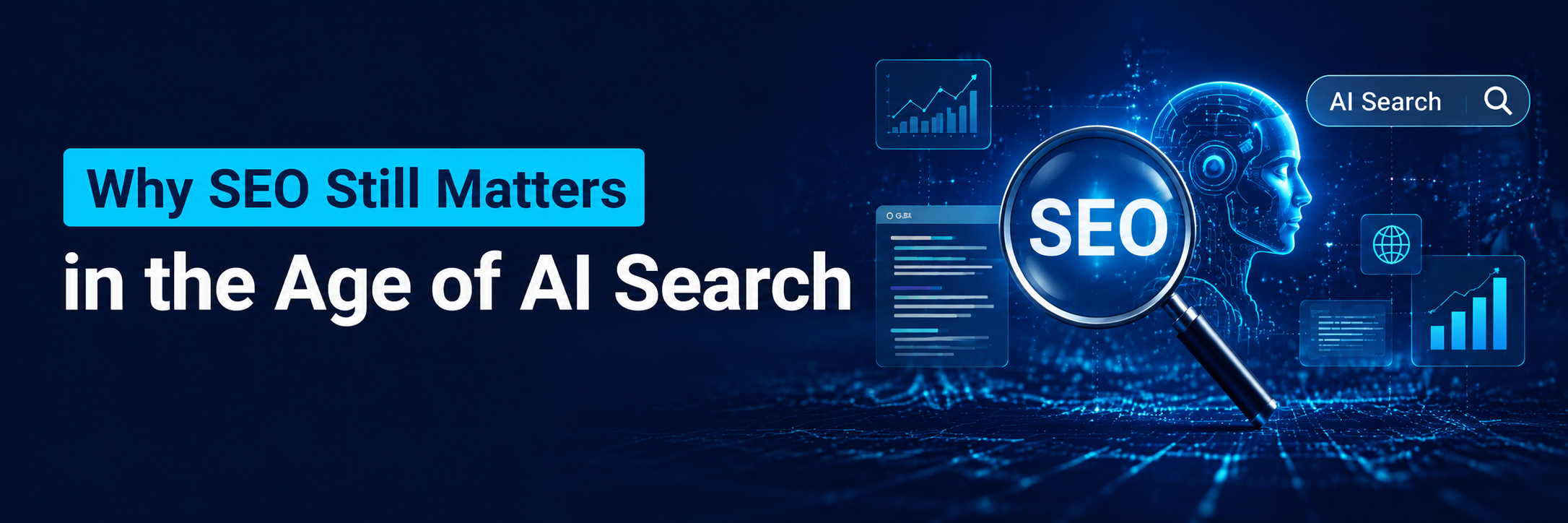
Every few years, someone declares SEO dead. It happened when social media took off. It happened when voice search became a thing. And now, with AI-powered search changing how people find information online, the conversation is back again. Louder this time, and honestly, more convincing on the surface.
But here’s the thing. SEO hasn’t died. It’s shifted. And understanding what that shift actually looks like is the difference between businesses that stay visible and ones that quietly disappear from search results over the next couple of years.
Google’s AI Overviews, Bing’s Copilot integration, and tools like Perplexity have changed the search experience in a pretty fundamental way. Users are increasingly getting synthesised answers at the top of the page before they ever scroll to a traditional blue link. So the old model of “rank on page one and get clicks” is genuinely being disrupted.
Traffic patterns are changing. Some industries are seeing click-through rates drop on informational queries because the AI overview answers the question well enough that users don’t feel the need to go further. That’s a real shift and it’d be dishonest to pretend otherwise.
But here’s what that actually means in practice. The content that gets pulled into those AI-generated answers has to come from somewhere. It comes from indexed pages. Credible, well-structured, authoritative pages. So the sites that invested in solid SEO foundations are the ones getting cited in AI responses. The sites that didn’t aren’t showing up anywhere, not in traditional results, not in AI summaries, not at all.
This is the part that gets glossed over in a lot of the “SEO is dead” conversations. AI search engines aren’t generating answers from thin air. They’re pulling from the web, and they’re doing it in ways that still heavily favour content that’s technically sound, properly structured, and built with authority signals that search engines have been measuring for years.
Page speed still matters. Mobile optimisation still matters. Structured data helps AI systems understand what a page is about. Internal linking tells crawlers how a site is organised. These are all traditional SEO concerns, and they’re still directly relevant to how AI systems discover, interpret, and surface content.
Google’s quality framework, Experience, Expertise, Authoritativeness, and Trustworthiness, has been around for a while. But in the current environment, it’s basically the central consideration for content visibility. AI systems are trained to favour content that demonstrates genuine subject matter knowledge. Thin content, recycled information, generic takes, these get deprioritised hard.
What this means practically is that first-hand experience, real credentials, named authors, cited sources, and content depth all matter more than they used to. A 600-word blog post covering a topic superficially isn’t going to compete. The bar has genuinely risen, and that’s actually good for businesses willing to invest in real content quality.
Some marketers treat technical SEO as an afterthought. A box to check once and forget. That approach was always a mistake, but it’s a more costly one now. AI crawlers and search bots need clean site architecture to properly index and understand content. Broken links, crawl errors, slow load times, duplicate content issues, all of these create friction that can quietly suppress visibility.
The businesses that are maintaining strong technical foundations are the ones that tend to weather algorithm updates and AI search transitions better. It’s not glamorous work. But it’s the kind of thing that compounds over time in very visible ways.
Here’s something that gets lost in the broad “AI is changing search” narrative. For local search, AI has changed relatively little so far. Someone searching for a dentist in their city, a plumber available on weekends, a restaurant for a Friday booking, those searches still largely route through traditional local SEO signals like Google Business Profile, reviews, local citations, and proximity data.
Similarly, niche and long-tail queries still perform well through traditional SEO. AI summaries tend to handle broad informational queries better than specific, complex, or localised ones. So businesses operating in defined geographic areas or specialist industries are seeing less disruption than general content publishers.
The practical response to AI search isn’t to abandon SEO strategy. It’s to evolve it. A few things worth focusing on:
SEO is not what it was in 2015. The tactics that worked then, keyword stuffing, low-quality link schemes, thin content volume plays, those are genuinely obsolete. But the core principle of SEO has always been about making valuable content accessible and credible to search systems. That principle is more relevant now, not less.
AI search rewards the same things good SEO has always rewarded: clarity, depth, authority, and technical accessibility. Businesses that understood SEO as “make good content findable” rather than “game an algorithm” are actually well-positioned for where search is heading.
The ones who need to rethink things are the ones who treated SEO as a shortcut. Because those shortcuts have been closing for years, and AI search is closing the remaining ones fast.
SEO still matters. Just not in the way it used to. And adapting to that distinction is, honestly, the whole game right now.